THINGS WORTH KNOWING · KITCHEN
Free for everyoneHalf a Recipe, Whole Snack
Turn a fruit salad for four into a snack for two. Learners halve each ingredient, compare amounts visually and explain why the whole recipe must change together.
Beginner knowledge · Grown-up guidance included
Print, think and try together.
Free PDF · No sign-in needed.
Download activity + grown-up guide · 2 pagesThe learner page is followed by its answer and grown-up guide. Page numbers match the complete collection.
BEFORE YOU BEGIN
What you need
A pencil; measuring cups are optional. A grown-up can help with halves and quarters.
No prior lesson is required. Adjust reading and writing support to the learner; pointing, speaking and drawing all count.
A PRACTICAL LIFE SKILL
What this builds
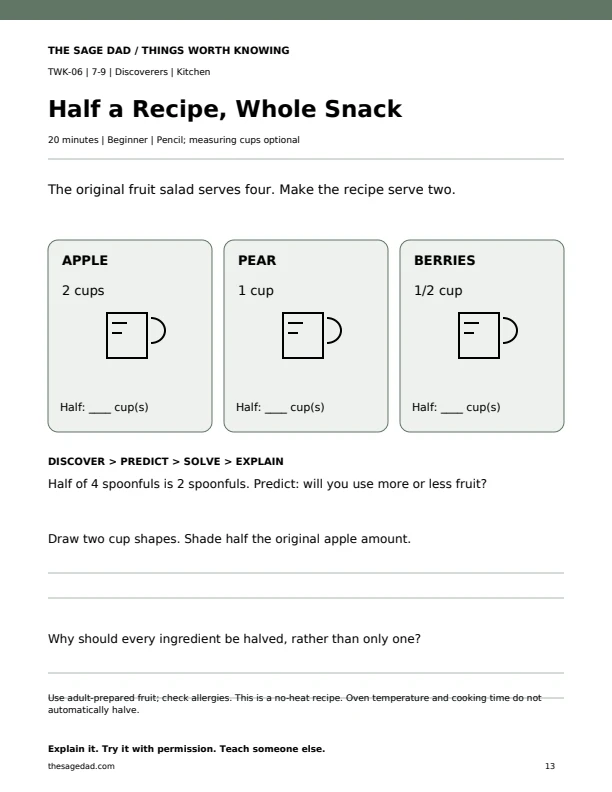
Halve 2 cups, 1 cup and ½ cup, and explain why every ingredient must keep its proportion.
A familiar recipe gives fractions a practical job and makes proportional thinking easier to discuss.
How to use the worksheet
Predict whether a recipe for two needs more or less fruit than a recipe for four.
Halve each ingredient and use the drawing space to show an amount.
Explain why halving only one ingredient changes the recipe.
Support for parents and teachers
This is a no-heat example. If making it, use adult-prepared fruit, check allergies and supervise. Oven temperature and cooking time do not automatically halve.
The second PDF page contains answers, reasoning, an optional real-world mission and a question for the grown-up. Keep it separate while the learner thinks.
Check the understanding
Ask the learner to show ½ cup and half of that amount using a drawing or measuring cups.
Invite a self-check: “I can explain it,” “I want another practice,” or “I need help.” The conversation matters more than a finished sheet.
An optional next step
Compare 1 cup, ½ cup and ¼ cup using water at a sink with adult support; dry any spills.
Use permission and adult support for real-world practice. The paper activity stands on its own.
Further reading for the grown-up
FoodSafety.gov: Four Steps to Food Safety. The worksheet’s scenarios are original Sage Dad teaching examples.
Keep exploring practical skills
- My First Kitchen Job — Kitchen Sequencing Activity for Ages 4–6
- Same Thing. Different Deal. — Unit Price Worksheet for Ages 7–9
- Find the Problem First — Troubleshooting Worksheet for Ages 7–9