THINGS WORTH KNOWING · HOME
Free for everyoneFind the Problem First
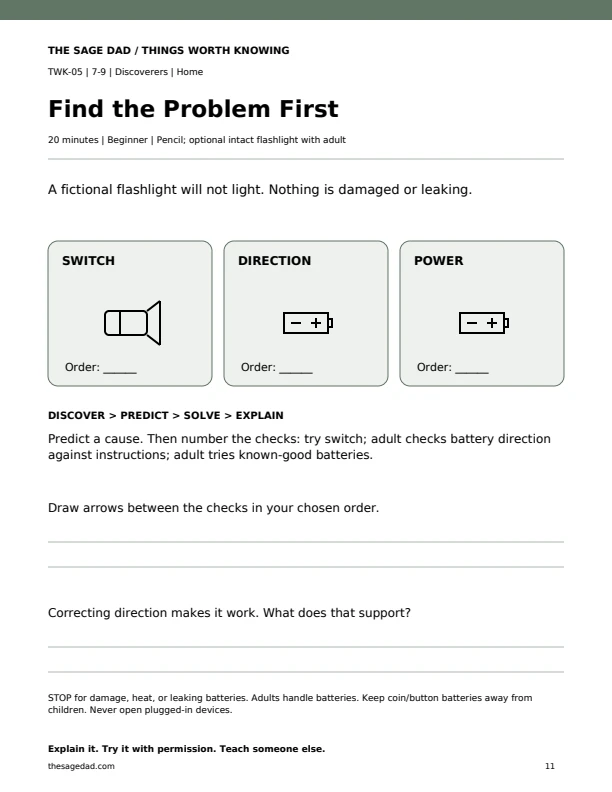
A fictional flashlight will not turn on. Before replacing anything, learners organize simple checks and use the result to explain what the evidence supports.
Beginner knowledge · Grown-up guidance included
Print, think and try together.
Free PDF · No sign-in needed.
Download activity + grown-up guide · 2 pagesThe learner page is followed by its answer and grown-up guide. Page numbers match the complete collection.
BEFORE YOU BEGIN
What you need
A pencil. An intact flashlight is optional and must be handled with an adult; the paper case is enough.
No prior lesson is required. Adjust reading and writing support to the learner; pointing, speaking and drawing all count.
A PRACTICAL LIFE SKILL
What this builds
Order simple checks and explain why changing one thing at a time helps identify a cause.
A careful description and a simple check can be more useful than guessing what to replace.
How to use the worksheet
Predict a possible cause using the undamaged fictional flashlight.
Number the switch, battery-direction and power checks in the exercise’s sequence.
Explain what is supported when correcting battery direction makes it work.
Support for parents and teachers
Adults handle batteries. Stop for damage, heat or leakage. Keep coin and button batteries away from children, and never open plugged-in devices.
The second PDF page contains answers, reasoning, an optional real-world mission and a question for the grown-up. Keep it separate while the learner thinks.
Check the understanding
Ask what changed and what result followed. Can the learner distinguish evidence from a guess?
Invite a self-check: “I can explain it,” “I want another practice,” or “I need help.” The conversation matters more than a finished sheet.
An optional next step
Describe a harmless or fictional problem using “what happened, what I noticed, what I tried.”
Use permission and adult support for real-world practice. The paper activity stands on its own.
Keep exploring practical skills
- Same Thing. Different Deal. — Unit Price Worksheet for Ages 7–9
- Half a Recipe, Whole Snack — Halving a Recipe Worksheet for Ages 7–9
- Measure Twice. Buy Once. — Measurement and Fit Worksheet for Ages 10–12