THINGS WORTH KNOWING · HOME
Free for everyoneMeasure Twice. Buy Once.
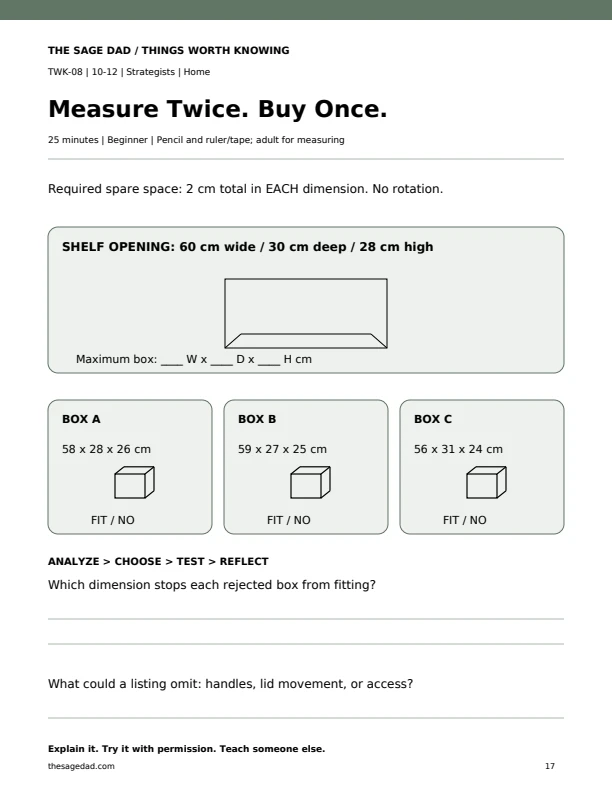
Will the box actually fit? Compare three sets of dimensions with a shelf opening, allow the stated spare space and explain which measurement rules out each unsuitable box.
Beginner knowledge · Grown-up guidance included
Print, think and try together.
Free PDF · No sign-in needed.
Download activity + grown-up guide · 2 pagesThe learner page is followed by its answer and grown-up guide. Page numbers match the complete collection.
BEFORE YOU BEGIN
What you need
A pencil. A ruler or tape measure and adult help are optional for measuring a safe tabletop object.
No prior lesson is required. Adjust reading and writing support to the learner; pointing, speaking and drawing all count.
A PRACTICAL LIFE SKILL
What this builds
Check all three dimensions against a stated clearance rule and identify missing information in a product listing.
Measuring before choosing helps turn “it looks about right” into a decision that can be checked.
How to use the worksheet
Subtract the exercise’s two-centimeter allowance from each opening dimension.
Compare every box’s width, depth and height with those limits; do not rotate the boxes.
Identify the dimension that fails and discuss handles, lids or access that a listing may omit.
Support for parents and teachers
The clearance rule is invented for this exercise, not installation advice. Use actual manufacturer requirements for real objects; do not climb or move heavy furniture.
The second PDF page contains answers, reasoning, an optional real-world mission and a question for the grown-up. Keep it separate while the learner thinks.
Check the understanding
Ask the learner to explain why a box with the right width could still fail to fit.
Invite a self-check: “I can explain it,” “I want another practice,” or “I need help.” The conversation matters more than a finished sheet.
An optional next step
Measure a small, safe tabletop object twice and label width, depth and height; ask an adult to check.
Use permission and adult support for real-world practice. The paper activity stands on its own.
Keep exploring practical skills
- Find the Problem First — Troubleshooting Worksheet for Ages 7–9
- The Cheapest Thing Costs More — Cost Over Time Worksheet for Ages 10–12
- The Leftover Detective — Food Safety Worksheet for Ages 10–12