THINGS WORTH KNOWING · KITCHEN
Free for everyoneThe Leftover Detective
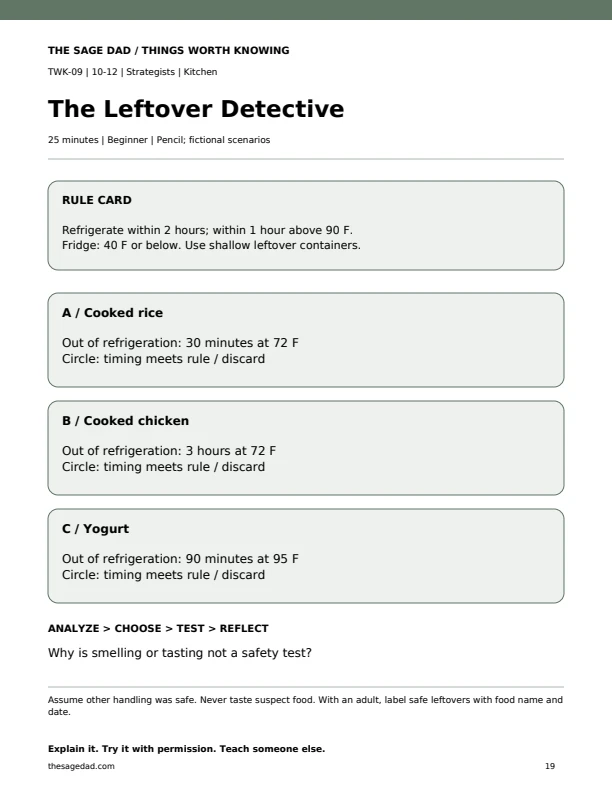
Become a detective using a rule card, not a taste test. Compare three fictional food-storage cases and explain how time and temperature affect the first decision.
Beginner knowledge · Grown-up guidance included
Print, think and try together.
Free PDF · No sign-in needed.
Download activity + grown-up guide · 2 pagesThe learner page is followed by its answer and grown-up guide. Page numbers match the complete collection.
BEFORE YOU BEGIN
What you need
A pencil and the printed rule card. Use the fictional cases rather than real questionable food.
No prior lesson is required. Adjust reading and writing support to the learner; pointing, speaking and drawing all count.
A PRACTICAL LIFE SKILL
What this builds
Apply the provided timing rules to three examples and explain why smell or taste cannot establish safety.
A clear rule and a careful question are more useful than guessing whether food seems fine.
How to use the worksheet
Read the rule card and identify the relevant time limit in each case.
Mark whether the case meets that timing rule or calls for discarding.
Explain why meeting the timing rule is only one part of safe handling.
Support for parents and teachers
Assume other handling was safe only in these paper cases. Never taste suspect food. Adults handle uncertain foods and consult food-specific storage guidance.
The second PDF page contains answers, reasoning, an optional real-world mission and a question for the grown-up. Keep it separate while the learner thinks.
Check the understanding
Ask why the hot-weather example has a shorter time limit. Check that the learner does not treat smell as proof.
Invite a self-check: “I can explain it,” “I want another practice,” or “I need help.” The conversation matters more than a finished sheet.
An optional next step
With an adult, label a safely stored leftover and locate the refrigerator thermometer.
Use permission and adult support for real-world practice. The paper activity stands on its own.
Further reading for the grown-up
FoodSafety.gov: Four Steps to Food Safety. The worksheet’s scenarios are original Sage Dad teaching examples.
Keep exploring practical skills
- My First Kitchen Job — Kitchen Sequencing Activity for Ages 4–6
- Half a Recipe, Whole Snack — Halving a Recipe Worksheet for Ages 7–9
- The Cheapest Thing Costs More — Cost Over Time Worksheet for Ages 10–12