THINGS WORTH KNOWING · MONEY
Free for everyoneThe Cheapest Thing Costs More
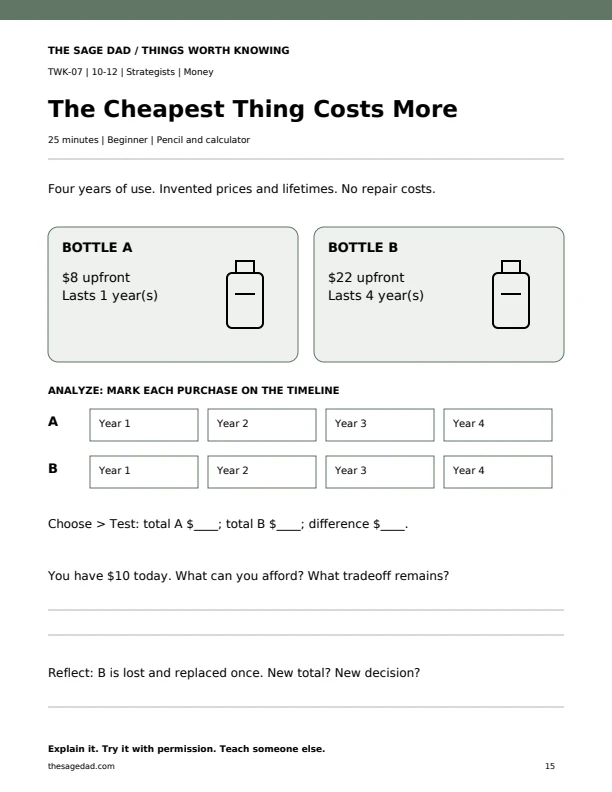
One bottle costs less today; another may cost less over four years. Use invented prices and lifetimes to compare totals, consider a limited budget and test what changes if a bottle is lost.
Beginner knowledge · Grown-up guidance included
Print, think and try together.
Free PDF · No sign-in needed.
Download activity + grown-up guide · 2 pagesThe learner page is followed by its answer and grown-up guide. Page numbers match the complete collection.
BEFORE YOU BEGIN
What you need
A pencil and calculator. No real purchases or product research are required.
No prior lesson is required. Adjust reading and writing support to the learner; pointing, speaking and drawing all count.
A PRACTICAL LIFE SKILL
What this builds
Calculate replacement costs over time and explain how affordability and assumptions can change a decision.
A price tag tells only part of a story. A useful comparison also considers how long something lasts and what might change.
How to use the worksheet
Mark each required purchase on the four-year timeline.
Calculate the two totals and consider what a ten-dollar budget allows today.
Test the changed assumption: the longer-lasting bottle is lost and replaced once.
Support for parents and teachers
Prices and lifetimes are fictional, not product claims. Treat affordability today and projected value as separate questions.
The second PDF page contains answers, reasoning, an optional real-world mission and a question for the grown-up. Keep it separate while the learner thinks.
Check the understanding
Ask which assumption changed the conclusion. Can the learner explain the difference between a forecast and a guarantee?
Invite a self-check: “I can explain it,” “I want another practice,” or “I need help.” The conversation matters more than a finished sheet.
An optional next step
Compare two products without buying them and record one missing piece of evidence.
Use permission and adult support for real-world practice. The paper activity stands on its own.
Further reading for the grown-up
Money as You Grow. The worksheet’s scenarios are original Sage Dad teaching examples.
Keep exploring practical skills
- The Five-Coin Choice — Money Choices Worksheet for Ages 4–6
- Same Thing. Different Deal. — Unit Price Worksheet for Ages 7–9
- Measure Twice. Buy Once. — Measurement and Fit Worksheet for Ages 10–12