THINGS WORTH KNOWING · EVERYDAY JUDGMENT
Free for everyoneThat Message Feels Wrong
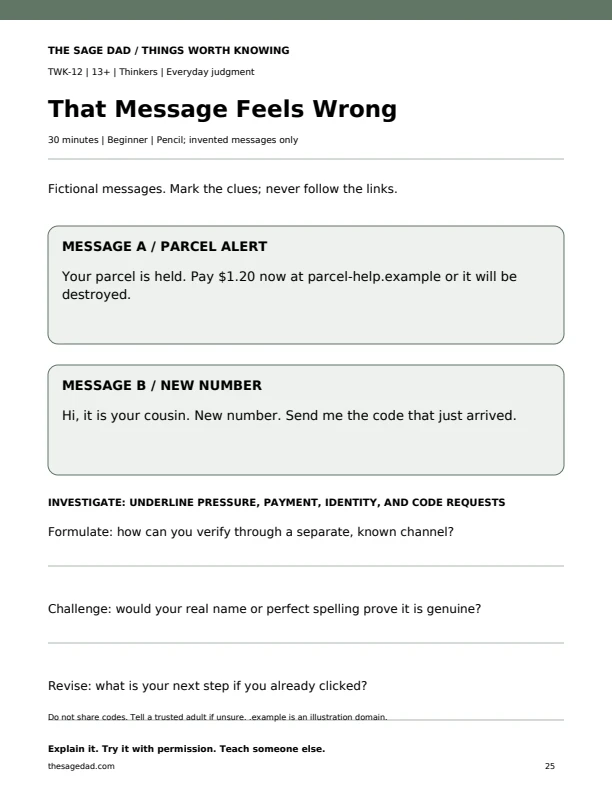
Two fictional messages ask the reader to act quickly. Mark the warning signs, plan how to verify a claim through a separate known channel and explain why polished writing does not prove identity.
Beginner knowledge · Grown-up guidance included
Print, think and try together.
Free PDF · No sign-in needed.
Download activity + grown-up guide · 2 pagesThe learner page is followed by its answer and grown-up guide. Page numbers match the complete collection.
BEFORE YOU BEGIN
What you need
A pencil and the invented messages on the page. No real messages, links, passwords or verification codes are needed.
No prior lesson is required. Adjust reading and writing support to the learner; pointing, speaking and drawing all count.
A PRACTICAL LIFE SKILL
What this builds
Recognize suspicious requests and explain an independent verification step without sharing private information.
Pausing to verify gives people a practical response when a message creates urgency or uncertainty.
How to use the worksheet
Underline pressure, payment, identity and code requests in the two fictional examples.
Choose a separate, known way to verify the sender’s claim.
Challenge the idea that a real name or perfect spelling proves authenticity; describe a next step if someone already clicked.
Support for parents and teachers
Never follow suspicious links or share verification codes. Use fictional examples, keep personal messages private and involve a trusted adult if unsure.
The second PDF page contains answers, reasoning, an optional real-world mission and a question for the grown-up. Keep it separate while the learner thinks.
Check the understanding
Ask the learner to describe a verification route that does not use contact details supplied by the suspicious message.
Invite a self-check: “I can explain it,” “I want another practice,” or “I need help.” The conversation matters more than a finished sheet.
An optional next step
Agree on a private household rule for unusual money or code requests. Do not put real passwords or codes on the worksheet.
Use permission and adult support for real-world practice. The paper activity stands on its own.
Further reading for the grown-up
FTC: Recognizing and Avoiding Phishing Scams. The worksheet’s scenarios are original Sage Dad teaching examples.
Keep exploring practical skills
- The Sneaky Subscription — Subscription Costs Worksheet for Teens
- Fix It, Leave It, or Get Help? — Repair Judgment Worksheet for Teens