THINGS WORTH KNOWING · HOME
Free for everyoneFix It, Leave It, or Get Help?
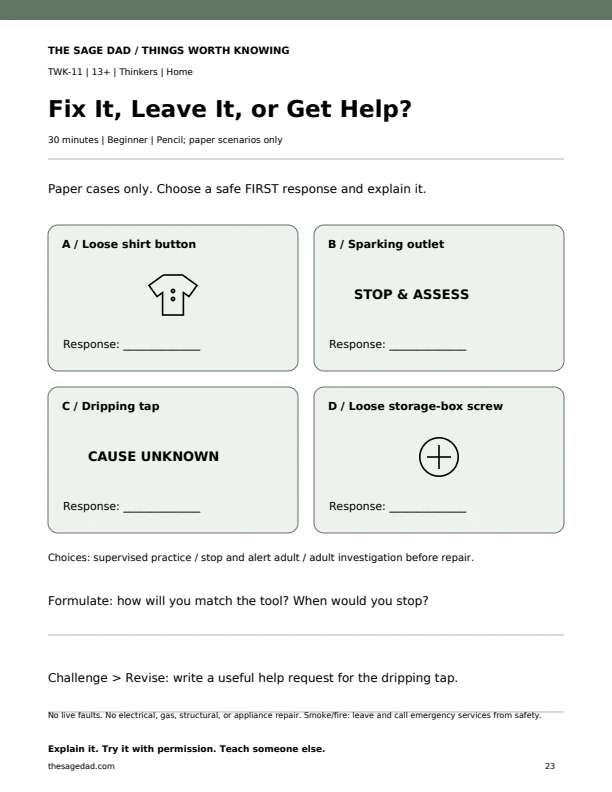
Knowing when to ask for help is a practical skill. Assess four paper scenarios, choose a first response and write a clear request for help without attempting a live repair.
Beginner knowledge · Grown-up guidance included
Print, think and try together.
Free PDF · No sign-in needed.
Download activity + grown-up guide · 2 pagesThe learner page is followed by its answer and grown-up guide. Page numbers match the complete collection.
BEFORE YOU BEGIN
What you need
A pencil. Use the paper scenarios only; no faulty equipment or repair tools are needed for the worksheet.
No prior lesson is required. Adjust reading and writing support to the learner; pointing, speaking and drawing all count.
A PRACTICAL LIFE SKILL
What this builds
Distinguish a supervised practice task from a problem that needs adult assessment or qualified help.
Good judgment includes recognizing uncertainty and describing a problem before acting.
How to use the worksheet
Read the four fictional household cases.
Choose the safe first response for each and explain the limit of independent action.
Write a useful help request for the dripping-tap case and name a reason to stop.
Support for parents and teachers
Do not reproduce faults. No electrical, gas, structural or appliance repair is part of this activity. Adults decide whether professional help is needed.
The second PDF page contains answers, reasoning, an optional real-world mission and a question for the grown-up. Keep it separate while the learner thinks.
Check the understanding
Ask what information a helpful request should include and which cases should not be touched or attempted.
Invite a self-check: “I can explain it,” “I want another practice,” or “I need help.” The conversation matters more than a finished sheet.
An optional next step
With adult permission and supervision, match a screwdriver to an intact screw on a harmless loose sample. No repair is required.
Use permission and adult support for real-world practice. The paper activity stands on its own.
Keep exploring practical skills
- Find the Problem First — Troubleshooting Worksheet for Ages 7–9
- Measure Twice. Buy Once. — Measurement and Fit Worksheet for Ages 10–12
- The Sneaky Subscription — Subscription Costs Worksheet for Teens