THINK · COMPUTER FOUNDATIONS · SESSION 4 OF 4
Free for everyoneTrace Detective
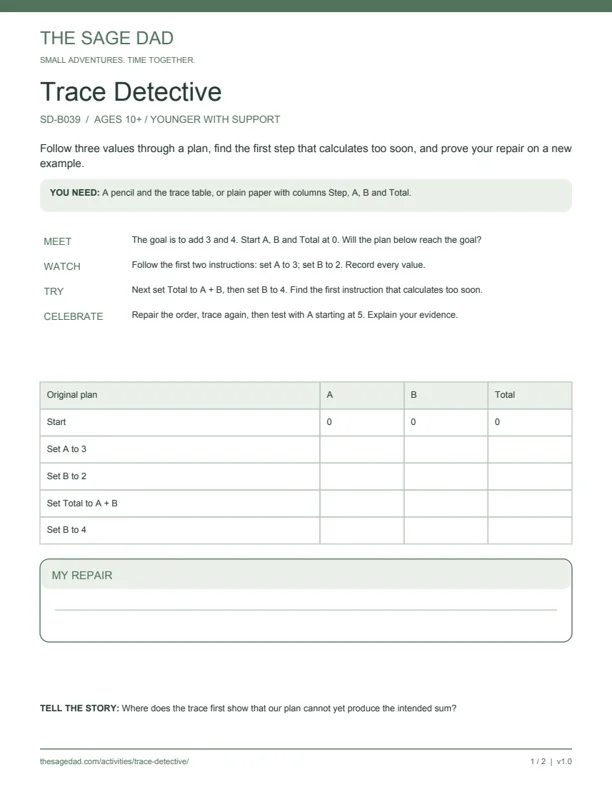
Follow three values through a plan, find the first step that calculates too soon, and prove your repair on a new example.
The Sage Dad · Computer Foundations · Confident knowledge
Take it to the table.
Free for everyone. 2 pages · US Letter · No sign-in needed.
Download printable · US LetterLearner sheet + grown-up guide. No printer? Follow the instructions below with plain paper.
BEFORE YOU BEGIN
Gather a few things.
A pencil and the trace table, or plain paper with columns Step, A, B and Total.
What to know first
Track separate stored values and explain that changing an input does not automatically update a previously calculated result. Try Number Keepers first if needed.
Tracing & debugging with evidence
What this helps you understand.
Learning goal: Record state after each instruction, locate an ordering bug, and test a repair with a new input.
Why it matters: A trace is evidence. It helps us find where a plan first differs from the intended behavior instead of changing things at random.
MEET · WATCH · TRY · CELEBRATE
Try it together.
State the goal
We want to add 3 and 4. Start A, B and Total at zero. Read the whole plan before running it.
Predict the original plan
The instructions are: set A to 3; set B to 2; set Total to A + B; set B to 4. Predict the final values.
Trace without skipping
Write one row after each instruction. Copy every unchanged value. Total becomes 5 and remains 5 even when B later becomes 4.
Repair the order
Move “set B to 4” before the addition, after “set B to 2.” Start from zero and trace again. The repaired Total is 7.
Test another input
Set A to 5 instead of 3. Predict the original Total and repaired Total, then trace both. Use the results to explain why the repair works.
One useful question
Where does the trace first show that our plan cannot yet produce the intended sum?
Evidence of understanding
Explain that the original addition reads B = 2, identify the ordering repair, and predict original Total = 7 versus repaired Total = 9 when A starts at 5.
A little help for the grown-up.
Expected reasoning and a common misconception
Original final values: A = 3, B = 4, Total = 5. Repaired final values: A = 3, B = 4, Total = 7. For A = 5, the original Total is 7 and repaired Total is 9. Updating B alone does not re-run an earlier addition.
Listen for: “The final B is 4, so Total must be 7.” Cover later rows and ask which B the addition actually read at that moment.
Accept pointing, speaking, drawing or writing. Finishing the sheet is not a grade.
Make it gentler
Return to Number Keepers. Use physical number cards and let the adult write one row at a time.
Add a little stretch
After the loops adventure, compare a countdown that reduces Left by 1 with one that reduces it by 0. Stop after five paper rounds and explain the difference between a safety limit and a correct stopping condition.
A good place to stop
Stop when the learner can justify the repair and apply it to a new starting value. A correct answer without a trace is an invitation to revisit the steps.
Make the support fit.
Age guides the presentation; knowledge chooses the starting point.
Explorers 4–6
begin with the gentler Number Keepers activity and adult narration.
Discoverers 7–9
use number cards and speak each change while an adult records.
Strategists 10–12
complete original and repaired traces and test a fresh input.
Thinkers 13+
explain why the repair works for any starting A; explore the optional loop boundary case.
THE SAME IDEA, INSIDE A COMPUTER
Watch it happen in the lab.
Use the stored-values adventure to observe the same read-and-write behavior. Then revisit the loops adventure for the stopping-rule stretch. The paper notation here is a teaching model, not a LearnRisc instruction set.
The current adventures use a limited practice simulator. LearnRisc integration awaits the creator handoff.