THINK · COMPUTER FOUNDATIONS · SESSION 1 OF 4
Free for everyoneBe a Human Computer
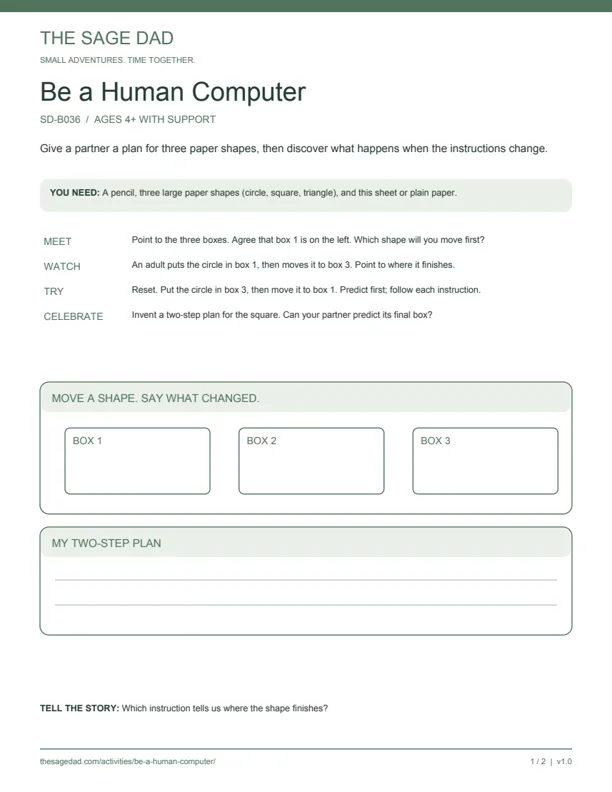
Give a partner a plan for three paper shapes, then discover what happens when the instructions change.
The Sage Dad · Computer Foundations · New knowledge
Take it to the table.
Free for everyone. 2 pages · US Letter · No sign-in needed.
Download printable · US LetterLearner sheet + grown-up guide. No printer? Follow the instructions below with plain paper.
BEFORE YOU BEGIN
Gather a few things.
A pencil, three large paper shapes (circle, square, triangle), and this sheet or plain paper.
What to know first
No coding or reading needed. Point to a shape and follow a direction with adult support.
Precise instructions & sequence
What this helps you understand.
Learning goal: Follow a precise two-step plan and explain how changing its order can change the result.
Why it matters: A program is a plan expressed as instructions. Clear words and a clear order help a machine do what we intend.
MEET · WATCH · TRY · CELEBRATE
Try it together.
Agree on the words
Draw three boxes in a row and number them 1, 2, 3 from left to right. Use one circle. One person gives directions and the other moves it.
Make a prediction
Say: “Put the circle in box 1. Move the circle to box 3.” Point to its predicted final box, then follow each instruction.
Reverse the plan
Reset and reverse the two instructions: put it in box 3, then move it to box 1. Ask what changed and which instruction decided the final position.
Repair an unclear instruction
Try “put the triangle next to the circle.” Could that mean two places? Agree on a precise box number and test the revised instruction.
Make it yours
Create a new two-instruction plan for the square. Swap roles. Ask your partner to predict before moving anything.
One useful question
Which instruction tells us where the shape finishes?
Evidence of understanding
On a fresh two-step plan, the learner predicts the final box and explains that the later move changes the earlier position.
A little help for the grown-up.
Expected reasoning and a common misconception
The original circle finishes in box 3; the reversed plan finishes in box 1. The second instruction determines its final position. Some instructions can be swapped without changing a result: placing two different shapes in two different empty boxes is one example.
Listen for: “The same two instructions always give the same result.” Pause after each move and point to where the circle is now.
Accept pointing, speaking, drawing or writing. Finishing the sheet is not a grade.
Make it gentler
Use one shape and two boxes. The adult reads; the learner points and moves. Say “now” after every move.
Add a little stretch
Find two instructions you can swap without changing the final arrangement. Explain why these differ from moving the same shape twice.
A good place to stop
Stop after one new plan the learner can explain. There is no need to fill every line.
Make the support fit.
Age guides the presentation; knowledge chooses the starting point.
Explorers 4–6
read aloud, point and move one large shape. Try 5–10 minutes.
Discoverers 7–9
give the directions aloud and swap roles. Try 10–20 minutes.
Strategists 10–12
write a plan and test an ambiguous direction.
Thinkers 13+
define a small instruction vocabulary and test when order matters.
THE SAME IDEA, INSIDE A COMPUTER
Watch it happen in the lab.
You changed the order of a plan. In the lab, watch what happens when a computer adds and doubles in a different order.
The current adventures use a limited practice simulator. LearnRisc integration awaits the creator handoff.