THINK · COMPUTER FOUNDATIONS · SESSION 3 OF 4
Free for everyoneRepeat Until...
Move one job at a time from Left to Done. Discover why a repeating plan needs both a changing count and a stopping check.
The Sage Dad · Computer Foundations · Familiar knowledge
Take it to the table.
Free for everyone. 2 pages · US Letter · No sign-in needed.
Download printable · US LetterLearner sheet + grown-up guide. No printer? Follow the instructions below with plain paper.
BEFORE YOU BEGIN
Gather a few things.
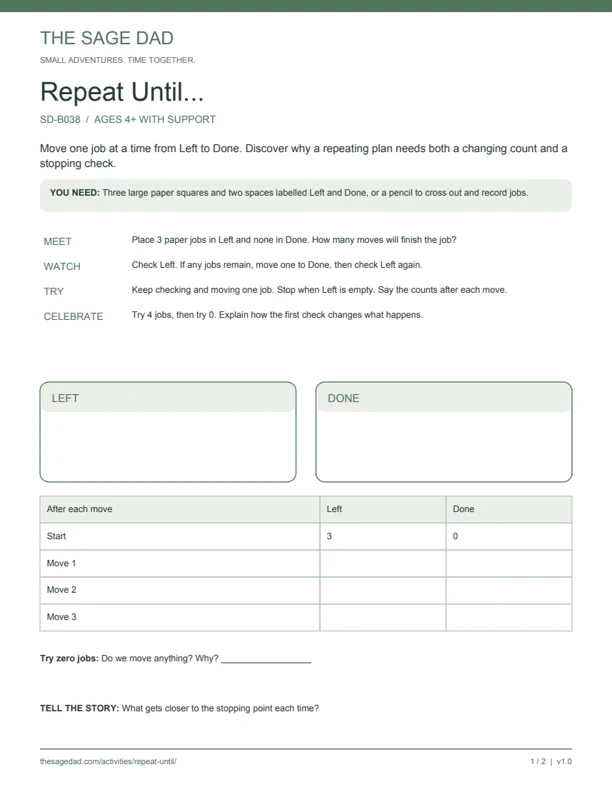
Three large paper squares and two spaces labelled Left and Done, or a pencil to cross out and record jobs.
What to know first
Follow a short sequence and count to 3, with adult support if needed.
Repetition & stopping conditions
What this helps you understand.
Learning goal: Identify a repeated action and explain what changes each time and what makes it stop.
Why it matters: A loop repeats useful work. A check and a change toward the stopping point keep that repetition under control.
MEET · WATCH · TRY · CELEBRATE
Try it together.
Set up the job
Label two spaces Left and Done. Put three large paper jobs in Left. Predict how many moves are needed.
Check before acting
Ask: “Are any jobs left?” If yes, move one job from Left to Done. If no, stop. Return to the question after each move.
Trace the counts
Say or record Left and Done after every move: 2 and 1, then 1 and 2, then 0 and 3.
Try a fresh count
Reset with four jobs. Predict Left = 0 and Done = 4 at the end. Then begin with zero jobs. Because we check first, no moves happen.
Find a broken rule
Imagine counting a job as Done without removing it from Left. Act out only three rounds, then stop the demonstration. Explain why the rule itself would never see an empty Left.
One useful question
What gets closer to the stopping point each time?
Evidence of understanding
The learner identifies the repeated move, the shrinking Left count, and the empty-Left stopping check. With zero jobs, they explain why this check-first plan does nothing.
A little help for the grown-up.
Expected reasoning and a common misconception
With three jobs, the trace is (Left, Done): (3,0), (2,1), (1,2), (0,3). With four it ends at (0,4). With zero it ends immediately at (0,0). If Left never shrinks, the rule never stops on its own.
Listen for: “The check alone makes it stop.” Ask what must change so that the answer to “any left?” eventually becomes no.
Accept pointing, speaking, drawing or writing. Finishing the sheet is not a grade.
Make it gentler
Use two jobs. Point to Left before every move. The learner moves the paper while the adult says the question.
Add a little stretch
Compare checking before the move with checking after the move. Which plan handles zero jobs? Explain the extra first check needed in a do-then-check program.
A good place to stop
Stop after the learner explains one fresh starting count. End any broken-rule demonstration after three rounds.
Make the support fit.
Age guides the presentation; knowledge chooses the starting point.
Explorers 4–6
move two large paper jobs with an adult asking the check.
Discoverers 7–9
keep a spoken or drawn count after every move.
Strategists 10–12
predict a new starting count and explain a broken rule.
Thinkers 13+
compare check-first and check-after behavior for a zero starting count.
THE SAME IDEA, INSIDE A COMPUTER
Watch it happen in the lab.
The lab also counts Left down and Done up. Its starter checks after doing a repetition and expects a positive starting count. Compare that with this paper activity, which checks first and can handle zero.
The current adventures use a limited practice simulator. LearnRisc integration awaits the creator handoff.